
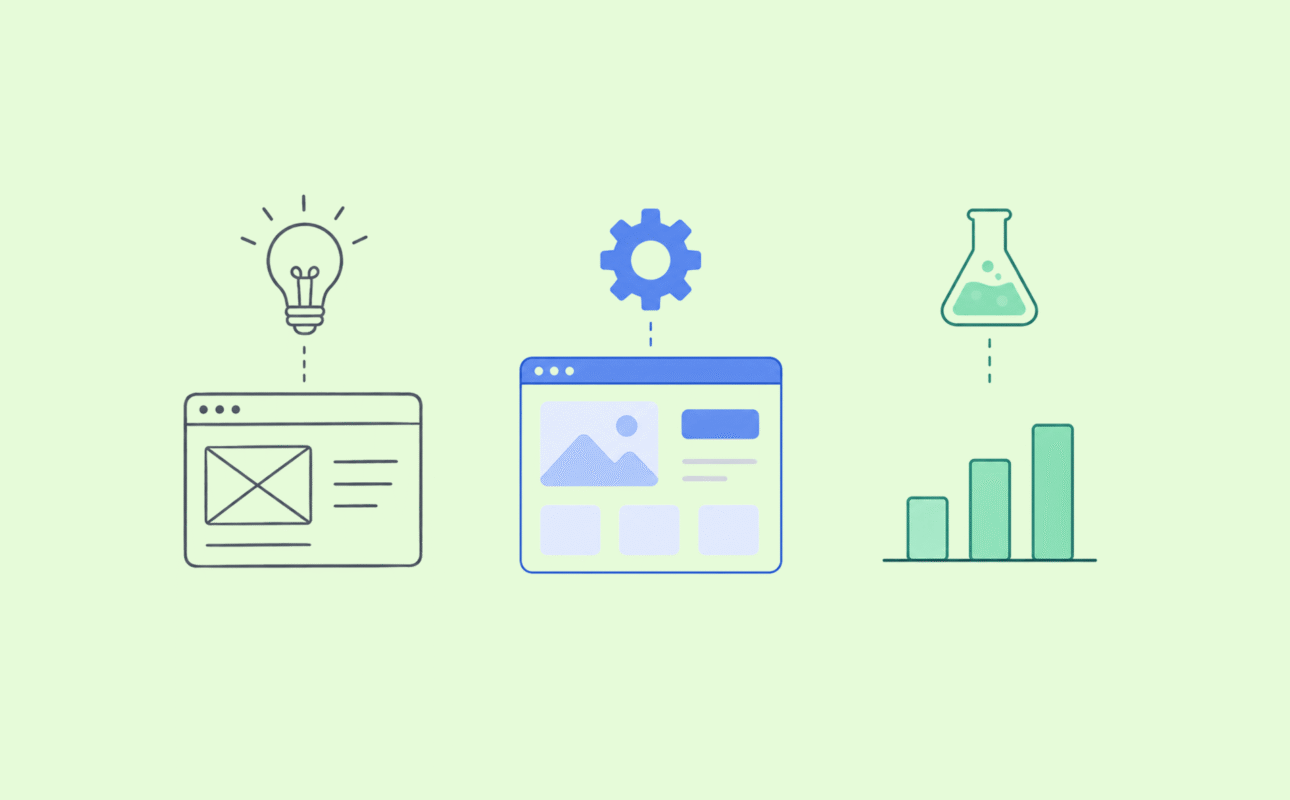
A proof of concept answers “can we build this?” A prototype answers “will users understand this?” A minimum viable product answers “will real users pay for or return to this?” These are three completely different questions. Building the wrong artifact at the wrong stage is one of the most reliable ways to burn runway without learning anything useful.
Most founders use all three terms to mean roughly the same thing. Investors sometimes do too. The confusion is understandable because all three happen before full product development and all three involve building something. But they serve fundamentally different purposes and choosing the wrong one at the wrong moment costs months and money you cannot get back.
This guide draws on over a decade of leading product design across global startups and SaaS companies. It explains exactly what each stage involves, when each one is the right choice, and how to sequence them so you validate fast without overbuilding.
What this guide covers:
- The precise definition of a POC, prototype, and MVP
- What question each one is designed to answer
- When to use each and when to skip straight ahead
- The most common sequencing mistakes founders make
- How AI tools have changed the timeline for each stage in 2026
- The decision framework to figure out which one you need right now
Why the Confusion Exists and Why It Is Expensive
Here is a scenario that plays out constantly.
A founder has a strong idea. They have done their research. They book a call with a design or development agency and say “we need an MVP.” The agency starts scoping a 12-week build.
Three weeks in, it becomes clear the founder actually needs a clickable prototype to validate the user flow with early users and close a pre-seed round. The MVP work is premature. Half the work gets thrown out.
This happens because “MVP” has become the default word founders use for “the first thing we build.” But the first thing you build should almost never be an MVP.
According to CB Insights analysis of 111 startup post-mortems, 42% of startups fail because there was no real market need for what they built. The validation tools that prevent this exist. Most founders just do not use them in the right order.
The right sequence is not always POC, then prototype, then MVP. It is: identify your biggest unresolved risk, then build the cheapest thing that resolves it. Sometimes that is a prototype. Sometimes it skips the POC entirely. Understanding what each stage actually does makes that decision obvious.
MVP vs Prototype vs POC: What a Proof of Concept Actually Is
A proof of concept is a focused technical experiment. Its only job is to answer one question: can this thing be built the way we are imagining it?
It is not a product. It is not shown to users. It does not have a user interface. It is a constrained technical test designed to confirm or rule out a core technical assumption before you invest in design and development.
A POC is appropriate when your product depends on something technically unproven. Examples:
- A novel algorithm whose accuracy at scale is uncertain
- A real-time data integration with a third-party system whose API behaviour is unknown
- A hardware-software integration where latency or reliability is genuinely unclear
- An AI or machine learning capability where model performance on your specific dataset is untested
The output of a POC is not a product. It is a decision. Either the technical approach works and you move forward with confidence, or it does not and you change the approach before spending months building on a flawed foundation.
A POC should take 1 to 3 weeks. If it is taking longer, one of two things is happening. Either the technical question is more complex than expected and needs to be broken into smaller experiments. Or the team has started building a product instead of running an experiment.
Most startups do not need a POC. If your product is a typical SaaS dashboard, a marketplace, a mobile app, or a website with standard integrations, the technology is proven. Go straight to a prototype.
| Start with a POC when… | Skip the POC when… |
|---|---|
| Your core feature requires an unproven algorithm or AI model | Your stack uses standard, well-documented technology |
| You need to test a complex third-party integration before committing | The technical approach has been used by similar products before |
| Hardware and software must interact in a way that has not been tested | Your biggest uncertainty is user experience, not technical feasibility |
| Investors specifically require a technical feasibility demonstration | You need to validate user demand, not technical possibility |
What a Prototype Actually Is

A prototype is a clickable, interactive simulation of your product. It looks like the real product and behaves like the real product. But it is not built with production code and it does not connect to a real backend.
Its job is to answer one question: will users understand how this product works and be able to complete the core journey without guidance?
A prototype is what you build when the design is your biggest unresolved risk. This is the case far more often than founders realise.
You can build a prototype in days. A good design agency can take a defined user flow and produce a clickable prototype in a week. That prototype can then be tested with 5 to 10 target users. What you learn from those tests shapes every design and development decision that follows.
Prototypes are the highest-ROI activity in early product development. A $5,000 prototype tested with real users resolves design assumptions that would otherwise cost $50,000 in development work to discover and fix post-launch.
Prototypes serve two distinct purposes and it helps to be clear about which one you need:
Validation prototype: Built to test with real users. Low to medium fidelity. Focused on whether users can complete the core task. The goal is to learn, not to impress.
Investor prototype: Built to communicate a vision. High fidelity. Polished. Focused on making the concept compelling and legible to someone seeing it for the first time. This is what most founders show in pre-seed decks.
Both are legitimate. But confusing them leads to building a beautiful investor prototype and then discovering through user testing that the flow does not work. Build the validation prototype first. Then polish it for investors once the flow is confirmed.
In product design work across 10+ global products, the most consistent finding from prototype user testing is this: what seems obvious to the design team is not obvious to the user. Not because the user is wrong. Because the designer knows too much. Five user tests on a prototype surface this problem in hours. The same problem found in a built MVP takes weeks to fix.
What an MVP Actually Is
A minimum viable product is a real, functional, deployed product. Users can sign up. Data is stored. The core action is completable end-to-end. It is not a simulation and it is not a demo.
Its job is to answer one question: will real users engage with, return to, or pay for this product?
The word “minimum” refers to features, not quality. An MVP with a confusing interface does not validate your product idea. It validates that your design was not ready to ship. The experience must be clear and reliable enough that a stranger can complete the core journey without guidance.
An MVP is built after the technical approach is confirmed (POC if needed) and after the user experience is validated (prototype). Building an MVP before those stages is not moving faster. It is spending development budget to answer questions that research and design would have answered for a fraction of the cost.
What an MVP must include:
- A complete end-to-end core user journey with no dead ends
- Real data storage and backend logic
- Onboarding that gets a new user to the core value without external help
- Empty, error, and success states designed for every key screen
- Enough visual polish to establish trust on first impression
- A feedback mechanism so you can learn from early users
What an MVP does not include:
- Advanced features that are not part of the core journey
- Multiple user types or roles unless both are essential to the core value
- Admin dashboards for internal operations
- Integrations that are not required for the core flow
- Anything the team added because it would be “nice to have”
MVP vs Prototype vs POC: The Key Differences Side by Side
| POC | Prototype | MVP | |
|---|---|---|---|
| Primary question | Can this be built? | Will users understand it? | Will users use or pay for it? |
| Audience | Internal team and technical investors | Users and investors | Real users |
| Fidelity | Technical, not visual | Visual, not functional | Fully functional |
| Typical timeline | 1 to 3 weeks | 1 to 3 weeks | 6 to 14 weeks |
| Typical cost | Low | Low to medium | Medium to high |
| Success metric | Technical feasibility confirmed | Usability validated, flow confirmed | Retention, activation, or willingness to pay |
| What you do with findings | Change or confirm the technical approach | Iterate on design before development | Iterate on product based on user behaviour |
| What happens after | Build a prototype | Build the MVP | Build version 2 |
The Right Sequence for Most Startups
Most early-stage founders do not need all three stages. The right approach depends entirely on where your biggest unresolved uncertainty lives.
If your biggest risk is technical: Start with a POC. Confirm the core mechanism works. Then move to a prototype.
If your biggest risk is whether users will understand your product: Start with a prototype. Test it with real users. Then build the MVP.
If your biggest risk is whether anyone will actually use or pay for it: Build a lightweight MVP as quickly as possible and get it into real users’ hands.
If you are raising a pre-seed round: You almost certainly need a high-fidelity prototype, not an MVP. Investors at the pre-seed stage are evaluating the vision and the team’s ability to execute. A polished prototype communicates both. An MVP in early development usually communicates neither.
The practical sequence for most software startups looks like this:
- Write the problem and the primary user on one page — free, takes one day
- Build a prototype focused on the core user flow — 1 to 2 weeks
- Test the prototype with 5 to 10 real target users
- Iterate on the design based on test findings
- Build a POC only if your core feature involves genuinely unproven technology
- Build the MVP with the validated design as the brief
Most teams that skip steps 2 and 3 spend 8 to 12 weeks in step 6 discovering the same problems that 2 weeks of prototype testing would have surfaced for a fraction of the cost.
Where Founders Go Wrong With Each Stage
Going Too Deep on a POC
A POC is an experiment. It has a question, a timebox, and a binary outcome.
Founders who spend 6 to 8 weeks on a POC are usually doing one of two things: over-engineering a technical answer to a question that did not need that level of rigour, or avoiding the harder and scarier question of whether anyone actually wants the product.
A POC that takes more than 3 weeks has stopped being a POC and started becoming a product without a user.
Treating a Prototype as an MVP
This is the most common mistake, especially among non-technical founders.
A prototype that looks polished and is smooth to click through can feel like a product. It is not. It has no data storage, no real backend, no edge cases handled, no error states beyond what was designed. Shipping a prototype as an MVP means your “product” breaks the moment a user does anything unexpected.
The confusion usually happens when a prototype is built for investors and starts to feel too good to rebuild. Rebuild it. The design decisions made in the prototype feed directly into the MVP build. They do not duplicate it.
Building an MVP When You Needed a Prototype
This is the expensive version of the confusion.
A founder spends 10 to 14 weeks and significant budget building a functional product. Real users engage with it. Half of them drop off in the onboarding flow. The problem is a design decision that a 2-week prototype test would have caught before a line of code was written.
This happens when the design is not validated before development begins. The fix is not faster development. The fix is running the prototype stage correctly before starting the MVP build.
Adding Investor Features to the MVP
An investor demo and a user product are not the same artifact.
Investors want to see vision, differentiation, and potential. They respond well to polished visuals, clear positioning, and the sense that the team knows what they are building.
Real users want a product that helps them do something specific without confusion. They do not care about features they cannot find or animations that do not reduce friction.
Build the MVP for the confused first-time user. The investor can navigate it from there. The real user cannot fake understanding they do not have.
How AI Tools Have Changed These Stages in 2026
AI has accelerated each stage significantly, but it has not changed what each stage is for.
Prototyping: Figma AI and tools like Galileo can generate initial UI layouts from text prompts in hours. This makes the prototype stage faster to start. The validation work — testing with real users, iterating on findings — still takes the same amount of time and judgment.
POC development: AI coding tools like Claude, GitHub Copilot, and Cursor help developers scaffold experiments faster. A POC that took 2 weeks in 2023 often wraps up in 3 to 5 days now. This is a genuine efficiency gain.
MVP development: Component libraries, AI-assisted code generation, and backend-as-a-service platforms have cut MVP build time significantly. Teams now ship in 6 to 8 weeks what used to take 14 to 16.
What has not changed: the sequence. Faster tools do not make skipping validation stages less expensive. They make it easier to build the wrong thing faster.
How to Know Which One You Need Right Now
Answer these three questions in order.
Question 1: Is there a core technical capability in your product that you genuinely do not know can be built?
If yes: start with a POC. If no: skip the POC.
Question 2: Have real target users (not friends, not advisors, not the founding team) seen and interacted with your core user flow?
If no: build a prototype and test it. If yes and the flow was validated: move to the MVP.
Question 3: Do you have a specific business hypothesis you need real user behaviour data to confirm?
If yes and your design is validated: build the MVP. If not yet: go back to question 2.
Most pre-seed founders answering these honestly find they are at question 2. Most Series A founders find they are at question 3. Almost nobody is at question 1 unless their product involves genuinely novel technology.
At Ruhcraft, the first question we ask any founder who comes to us saying “we need an MVP” is: what decision are you trying to make once this is built? The answer to that question tells us exactly which stage they actually need. Usually it is a prototype. Sometimes it is a POC followed by a prototype. Occasionally it is an MVP. We have never had a founder regret starting with a prototype first. We have met many who regretted starting with an MVP before validating the design.
FAQs on MVP vs Prototype vs POC
What is the difference between an MVP and a prototype?
A prototype is a clickable simulation designed to test whether users understand and can navigate your product. It is not functional and does not involve real data or backend logic. An MVP is a fully functional deployed product designed to test whether real users will engage with or pay for your core value. Prototypes are for design validation. MVPs are for market validation.
Do I need a POC before building a prototype?
Only if your product depends on a technically unproven capability. If you are building a typical SaaS product, a marketplace, or a mobile app using established technology and standard integrations, skip the POC. Go straight to a prototype. Most startups overestimate their technical risk and underestimate their design and product risk.
Can I show a prototype to investors?
Yes. A high-fidelity prototype is often the most effective investor artefact at the pre-seed stage. It communicates the vision clearly, demonstrates the user experience, and shows that the team can execute on design and product thinking. Many founders close pre-seed rounds using a prototype before writing a single line of production code.
How long should each stage take?
A POC should take 1 to 3 weeks maximum. A prototype should take 1 to 3 weeks for the design and 1 additional week for user testing and iteration. An MVP typically takes 6 to 14 weeks depending on scope and complexity. Any stage that significantly exceeds these timelines should be re-scoped.
What happens after the MVP?
The MVP generates real user behaviour data. That data tells you what is working, what is causing drop-off, and what users want next. Version 2 is built from that data, not from the founding team’s assumptions. This iteration cycle — ship, measure, learn, improve — continues for the life of the product.
The Bottom Line on MVP vs Prototype vs POC
MVP, prototype, and POC are not interchangeable terms for “the first thing we build.” They are three distinct tools that answer three different questions, used at different stages for different reasons.
Build the cheapest artifact that answers your most urgent unresolved question. Then move to the next stage.
For most pre-seed founders: prototype first. Test it with real users. Use it to raise. Then build the MVP with a validated design as the brief.
For founders with genuinely novel technology at the core: POC first. Confirm it works. Then prototype. Then MVP.
For founders who have already validated design and demand: build the MVP and start generating real user data.
The founders who get this sequence right validate faster, spend less, and ship products that real users understand from day one.
If you are figuring out which stage you are at and want a design partner who has led this process across 10+ global products, get in touch at ruhcraft.com/contact-us/.