
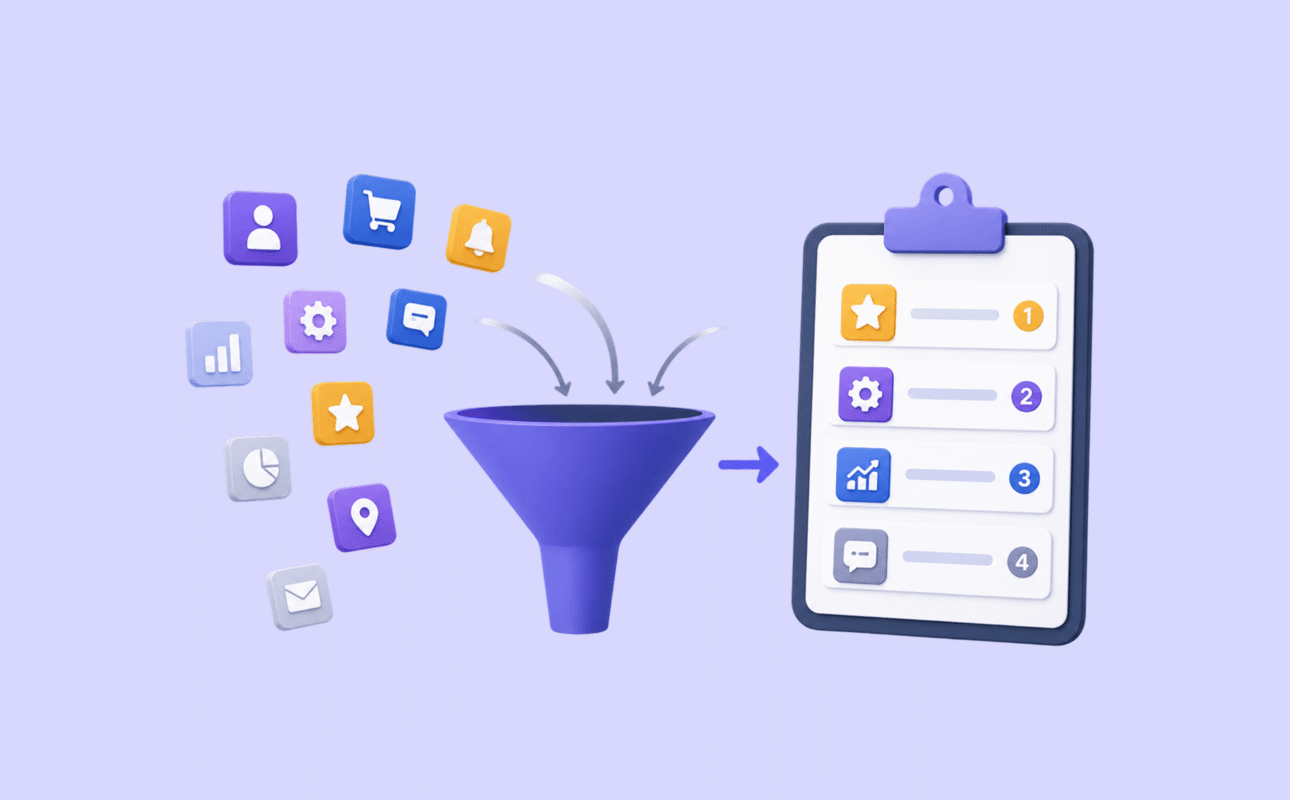
MVP feature prioritisation is the process of deciding which features belong in your first version and which ones wait. Every feature you add increases development time, design complexity, and the chance of shipping something users find overwhelming. Every feature you cut reduces cost, speeds up learning, and sharpens the product’s focus. Getting this decision right is one of the highest-leverage choices a founder makes.
Most founders get it wrong in the same direction. They add too much.
Not because they are undisciplined. Because every feature feels important when you are the one who thought of it. Because advisors keep suggesting things. Because competitors have things you do not. Because cutting something feels like admitting it is not worth building.
None of those are good reasons to keep a feature in an MVP.
According to Startup Genome research, 85% of startups that launch an MVP first are more likely to achieve successful scaling. Yet CB Insights analysis of 111 startup post-mortems consistently shows that 42% of startups fail because they built something nobody needed. The gap between those two statistics is feature prioritisation. The MVPs that lead to scale are focused. The ones that fail are not.
This guide covers how to make prioritisation decisions with clarity and confidence, which frameworks work in practice for early-stage products, and how to defend those decisions when everyone around you wants to add more.
What this guide covers:
- Why most MVPs are scoped too wide and how to fix it
- The single question that should govern every feature decision
- Four prioritisation frameworks with honest guidance on when each one applies
- How to handle the pressure to add features from advisors, investors, and co-founders
- What happens to cut features and how to manage that expectation
- How Ruhcraft approaches feature decisions in product design engagements
MVP feature prioritisation: Why Founders Build Too Much
There are three forces that consistently push MVP scope too wide.
The completeness instinct. Founders want the product to feel whole. A dashboard without reporting feels unfinished. A marketplace without reviews feels incomplete. An app without notifications feels like it is missing something. This instinct is not wrong — in a mature product. In an MVP it is the enemy of learning.
The competitive comparison trap. You look at competitors who have been building for three years and feel like your MVP needs to match their feature set. It does not. They spent three years learning which features mattered. You need to spend three months learning the same thing. You cannot shortcut that learning with more features.
The advisory pressure problem. Advisors, investors, and well-meaning friends suggest features constantly. Each suggestion sounds reasonable. Added together they turn a focused MVP into a bloated product that does not do anything well.
The result of all three: a product that takes four times as long to build, costs three times as much, and gives you half the signal you needed because users are confused about what the product is even for.
SaaS software companies spent $29.5 billion on unused features in 2025, per ProductLift research. For a startup, the equivalent cost is not just money. It is runway, momentum, and the time to find product-market fit before the money runs out.
The One Question That Governs Every Feature Decision
Before applying any prioritisation framework, every feature decision in an MVP should pass through one filter.
Does this feature directly help a new user complete the core journey for the first time?
Not a returning user. Not a power user. Not an edge case user. A new user, on their first session, trying to get value from the product for the first time.
If the answer is yes, the feature is a candidate for the MVP. If the answer is no, it is not. It goes on a backlog and it stays there until real users tell you they need it.
This filter is more powerful than any scoring framework because it forces you to define the core journey first. You cannot answer the question without knowing what the core journey is.
Your core journey is the single path through your product that delivers the primary value to the primary user. One path. One user type. One outcome.
Write it out as a sentence: “A [user type] arrives, does [action], and achieves [outcome].”
Every feature in your MVP should serve at least one step in that sentence. If it does not, it waits.
Four Prioritisation Frameworks That Actually Work

Frameworks do not make decisions. They structure thinking. The right framework depends on where your team is getting stuck in the prioritisation conversation.
Framework 1: MoSCoW for Quick Team Alignment
MoSCoW sorts every feature into four buckets:
- Must have: Without this the MVP cannot complete the core journey. It is non-negotiable.
- Should have: Important but not essential for launch. Improves the experience but the MVP works without it.
- Could have: Nice to have if time and budget allow. Has no real impact if left out.
- Will not have: Explicitly deferred. Not in scope, not now, not later in this phase.
The power of MoSCoW is the last bucket. Writing “will not have” forces a team to explicitly agree that something is out of scope. Without that explicit agreement, deferred features have a way of creeping back in during development.
Where MoSCoW works best: Early in the scoping process, when the team needs to get aligned fast without deep data. Good for non-technical founders and mixed teams.
Where it falls short: “Must have” lists have a tendency to grow. If more than 40% of your features end up in the “must have” bucket, you have not been ruthless enough. The whole point of MoSCoW is a small, honest must-have list.
| Bucket | Rule of thumb for an MVP |
|---|---|
| Must have | Only features without which the core journey is impossible. Usually 5 to 8 items maximum. |
| Should have | Features that significantly improve the experience. Usually 4 to 6 items. Ship in v1.1. |
| Could have | Nice-to-haves. Usually a long list. Ship based on user feedback, not assumption. |
| Will not have | Everything else. Written down explicitly so it cannot creep back in. |
Framework 2: RICE Scoring for Comparing Specific Features
RICE gives every feature a numerical score based on four variables.
Reach: How many users will this feature affect per month? Use actual numbers where possible.
Impact: On a scale of 0.25 (minimal) to 3 (massive), how much will this feature improve the experience for those users?
Confidence: What percentage of your estimate is based on validated data versus assumption? Express as a percentage.
Effort: How many person-weeks does this feature require across design and development?
RICE score = (Reach x Impact x Confidence) / Effort
Features with higher scores get prioritised. Features with lower scores wait.
A worked example for an MVP feature decision:
A founder is deciding between building a search function and improving the onboarding flow for a project management tool.
| Feature | Reach | Impact | Confidence | Effort | RICE Score |
|---|---|---|---|---|---|
| Search function | 200 users/mo | 1 (medium) | 50% | 6 weeks | 16.7 |
| Improved onboarding | 200 users/mo | 3 (massive) | 80% | 2 weeks | 240 |
The onboarding improvement scores 14 times higher. For a new product, that result is almost always the outcome because onboarding affects every single user at their most critical moment. Search affects users who have already found value. For an MVP, the sequence is clear.
Where RICE works best: When you have a shortlist of features and you need a structured, defensible rationale for which ones to build. Useful when pitching prioritisation decisions to investors or co-founders.
Where it falls short: The scores are only as good as your estimates. Reach and confidence are particularly prone to founder optimism. When in doubt, cut your confidence estimate in half and see if the decision changes.
Framework 3: Impact vs Effort Matrix for Visual Thinkers
Plot every candidate feature on a 2×2 grid:
- High impact, low effort: Build these first. They are your MVP core.
- High impact, high effort: Plan carefully. These are important but they carry risk. Include only if essential to the core journey.
- Low impact, low effort: Build later if there is spare capacity. Not in the MVP.
- Low impact, high effort: Cut entirely. These are the most dangerous features — they consume resources and deliver almost nothing.
The matrix is fast to run and easy to discuss with a mixed team. You can run it in a 90-minute workshop. Sticky notes work. A shared Figma file works. The tool does not matter. The honest conversation about where each feature sits does.
The most important outcome of this exercise: You will always find features in the “low impact, high effort” quadrant that were previously considered essential. Cutting those features is the single most valuable output of any feature prioritisation session.
Framework 4: The User Journey Audit (Most Underused)
This is the framework that senior product designers use most often and that almost no prioritisation guides cover.
Take your core user journey — written as a sequence of steps from arrival to value — and audit every candidate feature against each step.
For each feature, ask:
- Which step in the core journey does this feature support?
- Does the journey fail without it?
- Does it make a step meaningfully clearer or faster?
- Or does it add a parallel path that is not part of the core journey?
Features that do not map directly to a step in the core journey have no business being in the MVP. Features that make a step impossible to skip are must-haves. Features that make a step faster or clearer are candidates. Everything else waits.
This is the framework we use most at Ruhcraft. It connects every feature decision back to user behaviour rather than founder assumptions. When a founder says “we definitely need X,” the response is always: “Which step in the core journey does X support?” If they cannot answer that clearly, the feature is not ready for the MVP.
The Specific Features Most MVPs Do Not Need
After working on product design for 10+ global products, the same categories of features get added to MVP scopes repeatedly. Almost none of them belong there.
Advanced reporting and analytics dashboards. Users need to have meaningful data before they need a way to visualise it. In an MVP, that data does not exist yet. Build a simple activity log. Save the dashboard for version 2.
Notification systems beyond the basics. Email confirmation and password reset are necessary. A full notification preference centre with push notifications, in-app alerts, and digest emails is not. Every notification channel is a separate engineering workstream. Add them based on user requests, not assumptions.
Social features and community functions. Profiles, followers, feeds, comments, and sharing all require a critical mass of users before they provide any value. An MVP has no critical mass. These features add weeks to development and deliver nothing until you have hundreds of active users.
Admin panels and internal dashboards. You do not need a beautiful admin panel to manage 50 beta users. A spreadsheet works. A basic database interface works. An engineered admin panel in an MVP is a tool built for scale you do not yet have.
Multiple user roles and permission systems. Unless your core journey requires two distinct user types to interact — a marketplace where buyers and sellers both have to exist — one user role is enough for an MVP. Multi-role systems multiply design complexity and development time significantly.
Integrations with everything. One integration that is essential to the core journey is fine. A full integration library is a feature for a mature product with users who have proven they need it.
How to Handle Pressure to Add Features
Three scenarios happen in almost every early-stage product conversation.
The investor says “what about X?”
Investors often suggest features based on patterns they have seen across their portfolio. Some of those patterns will be relevant. Most will not apply to your specific product at your specific stage.
The right response is not to agree and add the feature. It is to ask which user behaviour they believe the feature will change, and whether that behaviour is part of your validated core journey. If it is, consider it. If it is not, note it and continue.
The co-founder says “we have to have Y or nobody will use it.”
This is an assumption. Assumptions need to be validated, not built. The right response is to commit to testing the assumption. If you launch without Y and real users say they cannot complete the core journey without it, add Y. If they do not mention it, the assumption was wrong and you saved weeks of development.
The advisor says “your competitor has Z.”
Your competitor built Z based on what their users needed after 18 months of learning. You are at day one. You do not have 18 months of user data. You have assumptions. Build for your assumptions, not for your competitor’s validated learnings.
The consistent response to all three: Write the feature down. Tell the person it is on the backlog. Commit to evaluating it after launch based on real user behaviour. Then launch without it.
What Happens to Cut Features
Cutting a feature from an MVP does not mean it will never be built. It means it will be built after you have confirmed that users want it.
That confirmation is valuable. A feature requested by 60% of your first 100 users has a user-validated business case. A feature added to the MVP before launch has an assumption. One of those is worth building with confidence. The other is a bet.
Set up a simple backlog. Every feature cut from the MVP goes there with a note explaining why it was cut and what user signal would justify adding it. Review the backlog at 30, 60, and 90 days post-launch with real usage data.
This process does three things:
- It gives team members confidence that their ideas are not being dismissed, just deferred
- It creates a prioritised roadmap for version 2 that is based on evidence
- It stops cut features from being “snuck back in” during development because they are officially captured and tracked
A Practical Feature Prioritisation Checklist
Before finalising your MVP scope, run every candidate feature through this checklist.
- Does this feature directly support a step in the core user journey?
- Can a real user complete the core journey without this feature?
- Have real users (not advisors, not investors, not the team) indicated they need this feature before they can get value?
- Does removing this feature save at least 1 week of design and development time?
- Does including this feature meaningfully increase the complexity of testing and debugging?
If the answer to question 2 is “yes, they can complete the journey without it” — the feature is not in the MVP. If the answer to question 3 is “we assume they need it but have not validated it” — the feature is not in the MVP.
The checklist is not about finding reasons to cut features. It is about finding features that genuinely have no business being in a first version.
MVP Feature Prioritisation in the AI Age
AI tools have changed the speed and cost of building in 2026. According to Startup Genome, 78% of startup founders report that AI tools have significantly reduced operational costs and accelerated product development.
This creates a new version of the same trap. When features are faster to build, the temptation is to build more of them. The logic sounds reasonable — if each feature costs half as much, we can afford twice as many.
This logic is wrong. The problem with too many features in an MVP is not primarily cost. It is signal quality.
An MVP that does 12 things gives you weak signal about which of those 12 things users actually care about. An MVP that does 3 things well gives you clear signal about which of those 3 things to double down on. Faster and cheaper development makes focused MVPs more achievable, not less important.
The startup that iterates based on 30 days of clear signal beats the startup that interprets 90 days of confused data every time. Startups that prioritise user feedback and iterate rapidly achieve 40% faster user acquisition, per Startup Genome research.
FAQs on MVP feature prioritisation
How many features should an MVP have?
There is no fixed number but most focused MVPs have between 5 and 12 features. A better way to think about it: how many screens does a user need to interact with to complete the core journey end-to-end? That number, plus the essential supporting screens (error states, empty states, onboarding), is roughly your MVP scope.
What is the difference between MVP feature prioritisation and product roadmap prioritisation?
MVP feature prioritisation is done once, before the first version ships, with the goal of identifying the minimum scope that tests the core hypothesis. Product roadmap prioritisation is an ongoing process done every sprint or quarter based on live user data. The frameworks overlap but the context is different. MVP prioritisation operates on assumptions. Roadmap prioritisation should operate on validated evidence.
Should I use RICE or MoSCoW for MVP prioritisation?
For most founding teams, start with MoSCoW to get aligned on what is genuinely essential versus nice-to-have. Then apply RICE to the shortlist of must-have and should-have features to determine which should-haves are strong enough to justify inclusion. Using both in sequence gives you the speed of MoSCoW and the rigour of RICE.
What if real users request a feature we cut from the MVP?
That is the system working correctly. A feature requested by real users after launch has a validated business case. Add it to the next development sprint with confidence. This is a much stronger basis for building than a pre-launch assumption. The goal of cutting features is not to avoid building them. It is to let users tell you which ones are worth building.
How do you handle a co-founder who disagrees with feature cuts?
Make the disagreement explicit and testable. Write down both positions: “We believe users can complete the core journey without X” versus “We believe users cannot complete the core journey without X.” Then launch without X and measure. Real user behaviour settles the disagreement faster than any team discussion and it removes the emotional charge from what is ultimately a testable hypothesis.
The Bottom Line on MVP feature prioritisation
MVP feature prioritisation is not about building less. It is about learning more from what you build.
Every feature you add to an MVP increases complexity, extends the timeline, and dilutes the signal you get from early users. Every feature you cut speeds up launch and sharpens the feedback you receive.
The founders who prioritise ruthlessly ship faster, learn faster, and build version 2 on evidence rather than assumption. The ones who add features because they feel necessary end up with a product that does many things adequately and nothing exceptionally.
Apply one filter to every candidate feature: does this directly help a new user complete the core journey for the first time? Build the ones that do. Defer the ones that do not until real users tell you otherwise.
If you are working through feature decisions for an MVP and want a design partner who has made these calls on 10+ real products, get in touch at ruhcraft.com/contact-us/.